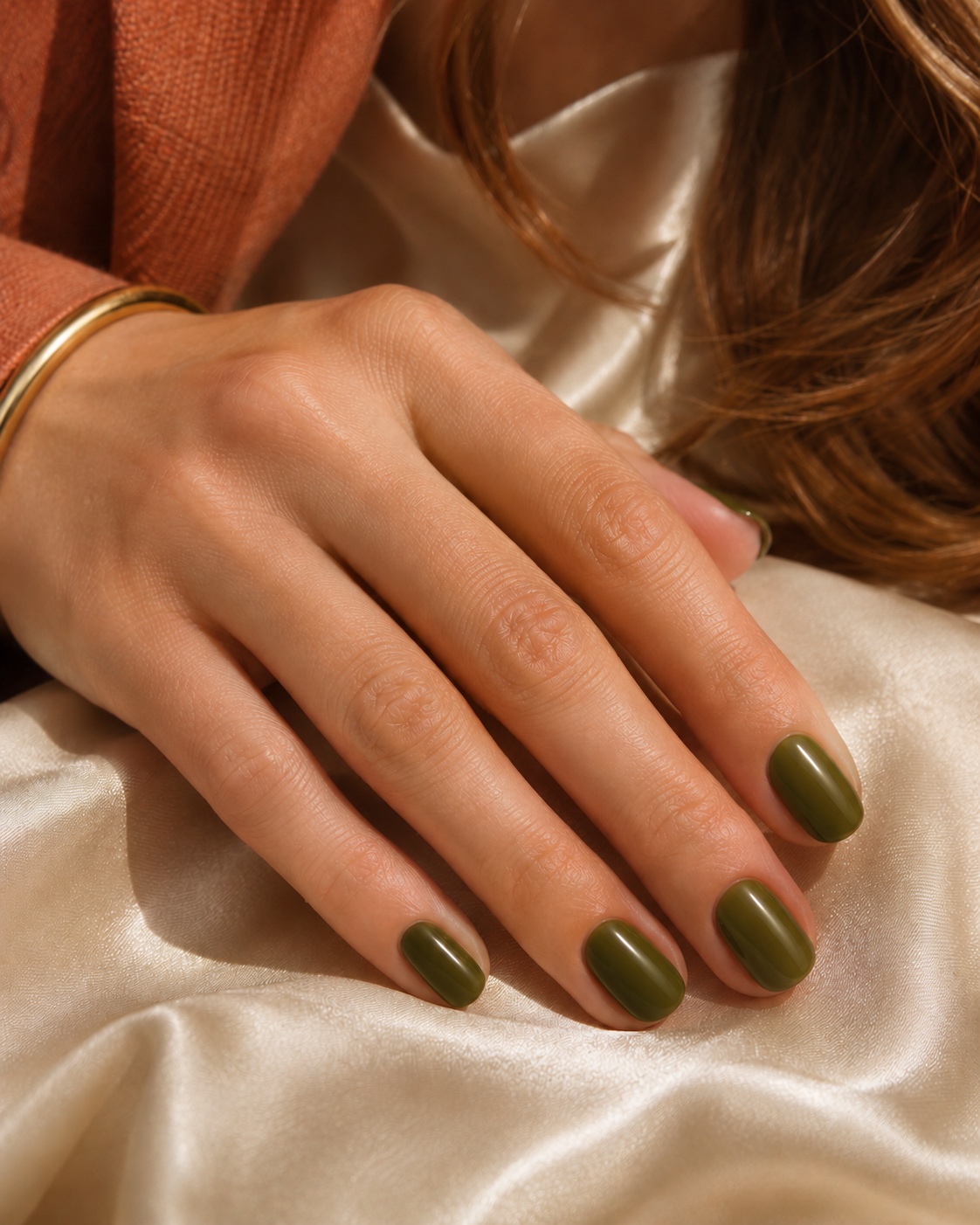
Olive nails are a muted yellow-green manicure, usually deeper and earthier than lime. Martini nails can mean that same green worn on its own or a manicure with small olive-inspired details, including a tiny red pimento dot. You can enjoy the look without drinking a martini, buying a particular polish or choosing elaborate nail art.
The useful decision is how much of the color you want to wear. A solid olive set reads differently from a sheer base with one small olive motif, even if both are described as martini nails. Below, compare shade directions, choose a level of detail, and follow the regular-polish tutorial if you want to try it at home.
Treat undertone suggestions as starting points, rather than permission slips. You can wear a golden green on cool-toned skin or a gray olive on warm-toned skin because you like the contrast. The best swatch is the one you enjoy seeing on your own hand.
What are olive and martini nails?
Allure's olive-nail trend report describes both deep yellow-green polish and olive-shaped art. It also reports rising cross-platform interest measured by trend forecaster Spate. That is third-party trend tracking, not AllWomenStalk search data or proof that one design is the most popular manicure.
You do not need a three-dimensional garnish to make the reference clear. A small green oval with a red dot can suggest an olive without turning a nail into a miniature sculpture. Equally, a clean glossy green manicure stands on its own if literal food-inspired art is not your thing.
Use the terms alongside a photograph when booking. One salon may understand martini nails as chrome and embellishments; another may picture a minimalist olive motif. Say whether you want a solid color, painted art, raised details or a combination, and ask for the service and time required before the appointment.
Thanks for your feedback! Couldn't send feedback. Try again?
The table below is editor styling guidance. It describes options to compare, not scientifically established matches between skin and polish.
If you want this effect
Try comparing these swatches
Warm and golden
A yellow-leaning olive beside a brown-leaning olive
Cooler and quieter
A gray olive beside a muted moss green
Deeper and dressier
A dark olive that still reads green in daylight
Softer contrast
A lighter muted olive or a sheer-base accent design
A small bright detail
An olive motif with a clear red pimento dot
Ask to see a swatch beside your bare hand, rather than choosing from the bottle across the room. Move it out of a strong colored light if possible. Notice whether you like the green against both your skin and the jewelry you actually wear.
If matching by undertone helps you start, comparing nail colors beside your own hand offers more information. You can use it to narrow the options and then choose by preference. There is no requirement to obey every suggestion once you find a shade you love.
Thanks for your feedback! Couldn't send feedback. Try again?
Report this addition
Three versions, from subtle to playful
A solid olive gloss
This is the easiest version to describe: one shade, the same finish across every nail, with no art. Put most of your attention into choosing a green you like. A short oval, rounded square or your usual natural shape can all carry the color without needing extra length.
Solid color is also a useful first attempt if you are unsure about green. You can judge the shade on its own before adding chrome, red details or a contrasting base at another appointment. Take a picture in ordinary daylight so your next reference reflects the actual manicure rather than salon lighting.
Olive with a restrained metallic accent
Keep the green as the main event and add a narrow metallic line, a small dot or a single accent nail. Decide whether you prefer gold, silver or a neutral shimmer by holding the options together. A little contrast can make the design feel deliberate without filling every nail with a different idea.
Tell the salon exactly where the accent should go. A screenshot with one detail circled is often clearer than asking for olive and chrome and hoping you share the same mental picture. Ask whether the chosen effect needs a different product system or removal process.
Tiny martini-olive art
Choose a sheer or neutral base, then place one or two green ovals with small red centers. Leaving space around the motif helps it read as intentional. You can keep the rest of the nails solid olive if you want a stronger green impression.
For a first home attempt, practice one motif on a disposable surface or practice tip. The aim is to learn how much polish the tool holds. It does not need to look like an illustration of a whole cocktail: the color and one small detail can do the work.
Thanks for your feedback! Couldn't send feedback. Try again?
Report this addition
DIY olive art with regular nail polish
This tutorial uses ordinary air-drying lacquer, not a gel system. Follow each product's directions and do not improvise curing times or mix systems based on these steps.
Prepare a clean surface. Remove old polish as directed and choose a manageable shape. Avoid cutting living skin around the nail. If a nail or surrounding skin is sore or damaged, pause the decorative manicure.
Apply your base coat. Use the product directions for the amount and drying time. Put the tools within reach before you start so you are not opening bottles with wet nails.
Add the background color. Apply thin coats of the selected neutral or olive shade, allowing the recommended drying time. A thick coat makes small details harder to place neatly.
Make the green oval. Place a small amount of polish on a disposable palette. Use a clean dotting tool to create a small rounded shape on the accent nail. Start smaller than you think you need.
Add the pimento detail. After the green is ready for the next step, use a smaller tool to add a little red dot. Let the shapes remain simple; repeated corrections can turn a tiny motif into a blob.
Finish according to the top-coat instructions. Let the design reach the recommended stage before sealing it. If your first attempt smears, give the next test more drying time rather than repeatedly brushing over it.
Clean your tools according to their instructions and keep polish off the surrounding skin. Our healthy-nail dos and don'ts are a useful reminder that the condition of the nail matters more than finishing the design today.
Thanks for your feedback! Couldn't send feedback. Try again?
Report this addition
If you're tired of your same old nail polish and want to shake things up a bit, you're in the right place. Here we provide some trendy and unique nail colors options for you. Enliven your style and let your fingertips do the talking. Get ready for the compliments!
Shape and finish without extra pressure
An oval nail is an easy visual partner for an olive motif because the shapes echo each other. That does not mean you need to file your nails oval if you prefer a rounded square or already have a shape that works for your hands. Ask the artist to adapt the motif to your available nail space.
Gloss makes the color look reflective; a matte finish gives it a different character. If your main reference depends on a shiny finish, say that explicitly. A bottle with a similar color but a different finish may not give you the effect that first caught your attention.
Also think about your plans after the appointment. An intricate raised detail may be less convenient than painted art if you use your hands heavily, and you can ask about that before choosing it. A simpler design that suits your week is a complete manicure, not a compromise you need to apologize for.
Thanks for your feedback! Couldn't send feedback. Try again?
Try: “I'd like a muted olive-green manicure, more mossy than neon, with a glossy finish. Please show me a warmer and a grayer swatch. I want short oval nails and one painted olive accent with a tiny red dot, without raised embellishments.”
Change the shape and details to match what you actually want. Ask to approve the shade and motif size before the artist repeats the design across the set. That is easier than realizing at the end that martini meant something very different to each of you.
Thanks for your feedback! Couldn't send feedback. Try again?
Report this addition
Frequently asked questions
Are olive nails the same as chartreuse nails?
No. Olive is generally deeper and more muted. Chartreuse is a brighter yellow-green direction. A reference picture helps make the distinction clear.
Do martini nails have to include nail art?
No. You can wear a solid olive shade and still enjoy the mood of the trend. The literal olive motif is optional.
What shape should I choose?
Pick a shape you like and can maintain. Oval works neatly with the motif, but the design can be adapted to other shapes and short natural nails.
Can I do this without gel?
Yes. The tutorial above uses regular air-drying polish. Follow the individual products' application, drying and removal directions.
Which olive is right for my skin tone?
Compare a warmer, a grayer and a deeper swatch beside your own hand. Undertone guidance can help you start; your preference decides the result.
Thanks for your feedback! Couldn't send feedback. Try again?
Report this addition
Feedback Junction
Where Thoughts and Opinions Converge
Keep exploring
Search AllWomenStalk for your next read.
Add allwomenstalk.com as a preferred source on Google to see more of our trusted coverage when you search.
Don't Miss the Latest Version
Get the latest stories, save favorites, and share with friends — all in one place.
Choose the look that feels most comfortable for reading.
Your choice is saved on this device only.
Read Allwomenstalk in the app
A calm, image-forward feed of fashion, beauty, wellness and relationship stories. Save your favourites and discover what fits your mood — all on your iPhone.





Feedback Junction
Where Thoughts and Opinions Converge